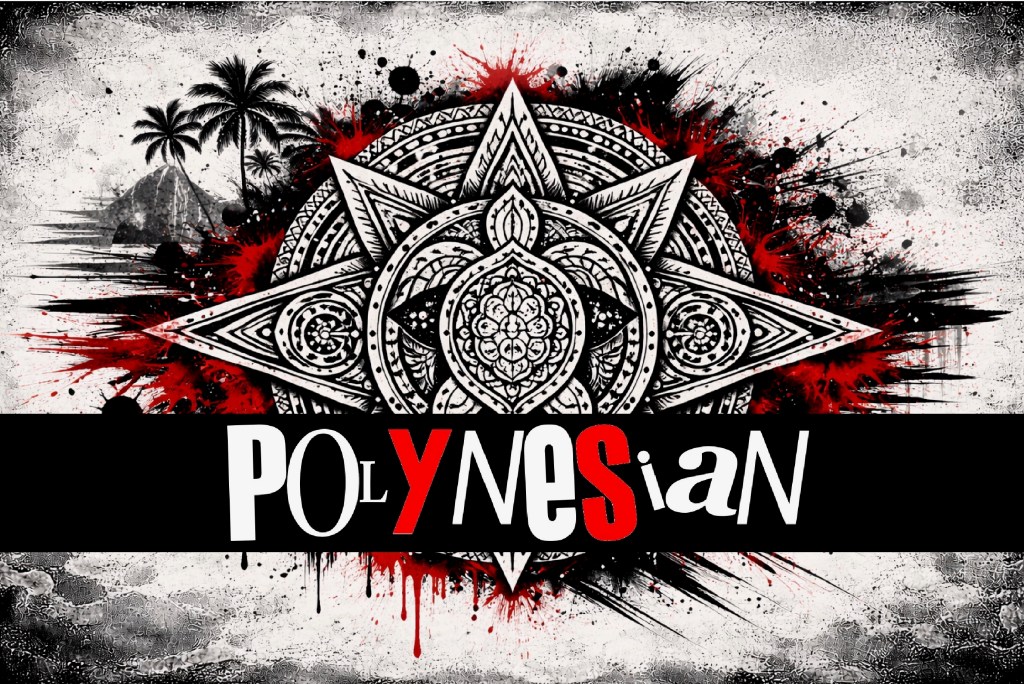
The term Polynesian incorporates many tribes including Marquesans, Samoans, Niueans, Tongans, Cook Islanders, Hawaiians, Tahitians and Maori. Southeast Asia and in turn, Polynesia are sub-regions of Oceania, comprising of over 1000 islands scattered over the central and southern Pacific Ocean, within a triangle that encompasses New Zealand, Hawaii and Easter Island.
Polynesian’s used tattoo art that was full of distinctive signs to express their identity and personality as there was no writing in Polynesian culture. Tattoos would indicate status in a hierarchical society as well as sexual maturity, genealogy and ones rank within the society. Nearly everyone in ancient Polynesian society was tattooed.
The actual tradition of Polynesian tattooing existed more than 2000 years ago.
It was in Tonga and Samoa that the Polynesian tattoo developed into a highly refined art. Tongan warriors were tattooed form the waist to the knees with a series of geometrical patterns, mostly consisting of repeated triangle motifs, bands and also areas of solid black. The Samoan warrior’s tattoo began at the waist and extended to just below the knee. However, it was not unusual for Samoan women to be tattoo too. Around 200AD voyageurs from Samoa and Tonga settled in the area of Marquesas. Over a period of more than 1000 years one of the most complex Polynesian cultures evolved – Marquesan.
Marquesan art and architecture were highly developed and Marquesan tattoo designs, which often covered the whole body and were the most elaborate in Polynesia.
The permanent marks left on someone after they have been tattooed would forever remember and commemorate their endurance and dedication to cultural traditions. The pain was extreme and the risk of death by infection was a huge concern for many people. However, shying away from tattooing was a risk of being labeled a coward or a pala’ai, resulting in being hated and insulted by the rest of the tribe or clan. The men who could not endure the pain and abandoned their tattooing were left incomplete, wearing their mark of shame throughout their life.
The artist would use a mallet to tap the teeth of the ink-laden comb into the man’s flesh, following only simple marks as guidelines. A tattooing session typically lasted until dusk or until the men could no longer stand the pain and would resume the following day, unless the inflamed skin needed a few days to heal. The entire process could last up to three or even four months. Placement on the body plays a very important role in Polynesian tattooing. Some elements have specific meanings based on where they are placed. The upper part of the body is related to the spiritual world and heaven, whilst the lower part of the body is related to the world and to earth.
Traditional positioning should not keep you from placing your tattoos on any part of the body you may feel appropriate for you: we believe a design should be meaningful to his owner before anyone else.
Human figures, otherwise known as enata in Marquesan language, represent men, women and sometimes gods. They can be placed within a tattoo to represent people and their relations. If they are placed upside down then they can be used to represent defeated enemies.
Shark teeth or niho mano deserve a space of their own. Sharks are one of the favourite forms that aumakua choose to appear to man. They represent protection, guidance and strength as well as fierocity however.
The spear is another classic symbol that is used to represent warrior nature.
The stylisations of the ocean can often represent ideas such as life, change and continuity through change. Waves can also be used to represent the world beyond or the place where the departed go and rest on their last voyage.
Tiki symbolise protection, fertility and they serve as guardians.
The turtle or honu is another important creature throughout all Polynesian cultures and has been associated with several meanings like health, fertility, longevity in life, foundation, peace and rest.
Lizards are very powerful creatures who bring good luck, communicate between the humans and the gods and who can access the invisible world.
The sting-ray is classed as a symbol of protection. Other meanings associated to the sting-ray image are adaptation, gracefulness, peacefulness, danger, agility, speed and stealth.
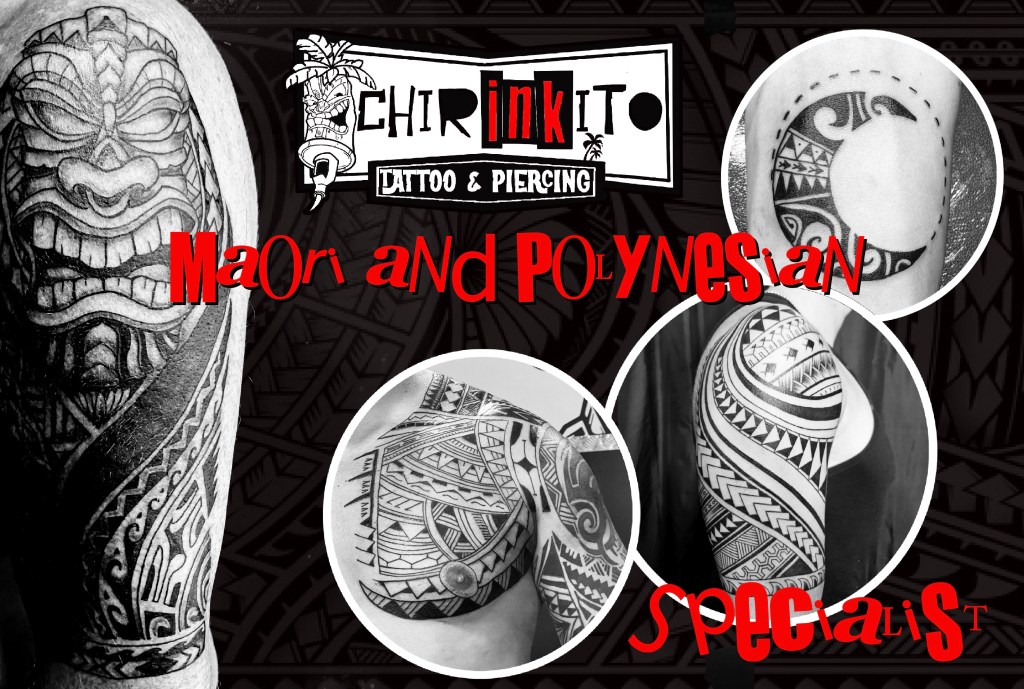
At Chirinkito, your tattoo experience is tailored to reflect your story and values, creating a meaningful connection between your identity and the artwork on your skin. Tell us about your vision and what you want your tattoo to represent, we will then design a piece that is uniquely yours, honoring the traditions behind your tattoo. With top-quality materials and our talented team of professionals artists your tattoo will not only look stunning but also stand the test of time.
 Chirinkito tattoo & piercing