
Piercing and Aftercare
Chirinkito is the piercing studio of choice while on holiday.
We strive for excellence in our body piercing services and the best experience for our customers. Our friendly and professional piercers will advise you on the best areas to pierce and show you our fantastic line of jewellery for you to choose from.

Your safety is our top priority and we ensure every piercing is performed in a safe professional environment.
Your body deserves the best and at Chirinkito we are here to provide it.


Entering the world of piercings can be quite confusing with all the options out there! Sometimes, it’s hard to figure out what a piercing is called or where it goes. We have put together our handy Chirinkito piercing guide to help you understand the lingo.
Ear piercings
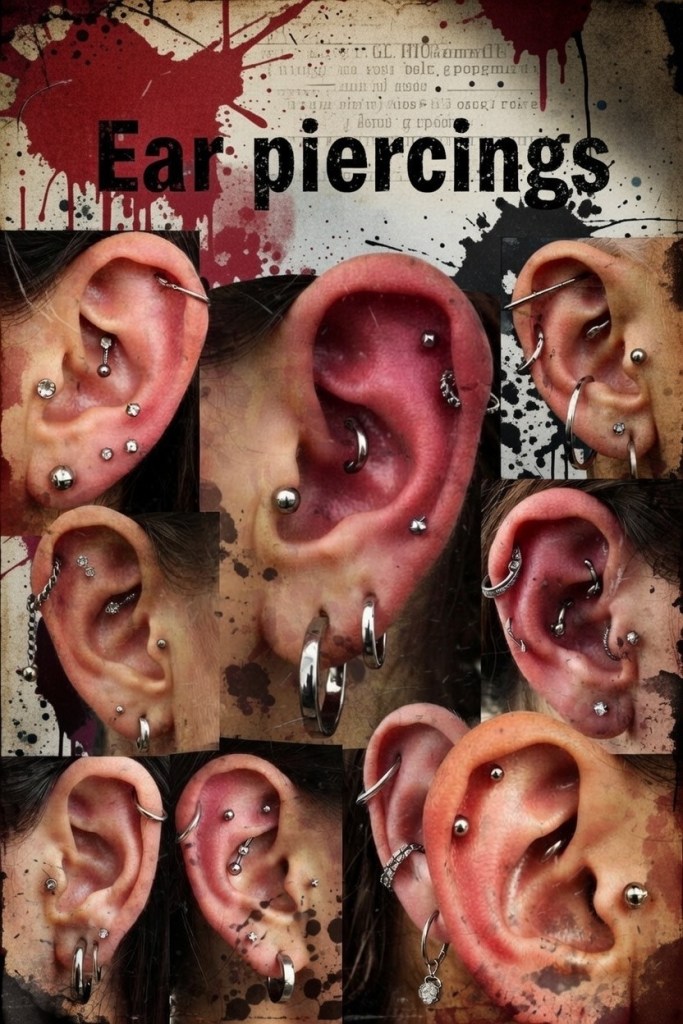
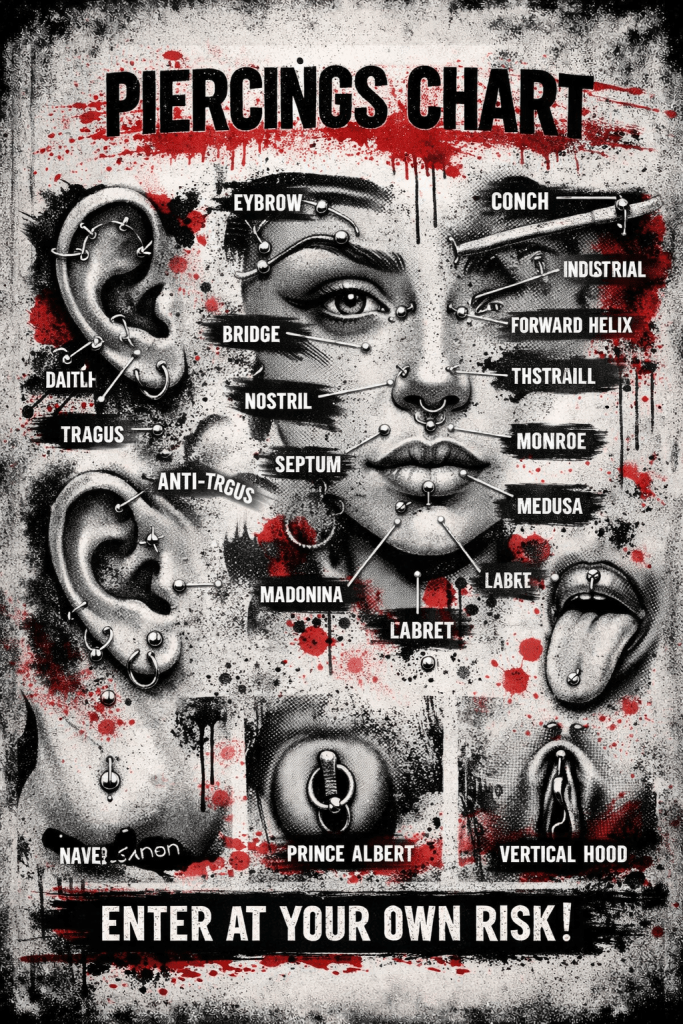
EARLOBE: The classic “first” piercing, which include any piercing that goes through the soft tissue of the ear . These will be some of the faster healing piercings since they don’t go through cartilage.
STACKED LOBE: These started as a way to deal with off center or asymmetrical piercings that people were unhappy with. It consists into fitting multiple piercings on the lobe in fun clusters, stacks and designs.
HELIX: Helix refer to piercings around the upper outer edge of the ear.
FORWARD HELIX: Piercings along the cartilage ridge closest to the head.
CONCH: These are piercings in the inner bowl of the ear, often worn with rings or chains once healed.
ROOK: A rook piercing is an ear piercing that’s located in the fold of cartilage between the upper part of the ear and the innermost ridge.
FAUX ROOK: A faux rook piercing is basically a flat piercing being placed near the rook fold but exits out the back of the ear.
FLAT: The flat piercing is located on the flat part of the upper ear, between the helix and the forward helix.
TRAGUS: Situated on the triangular piece of cartilage that partially covers the ear canal. These piercings can add a nice balance if you have a lot of piercings on the outer helix of your ear.
ANTITRAGUS: The antitragus piercing is positioned on the small ridge of cartilage just opposite the tragus, on the inner side of the ear.
INDUSTRIAL: The industrial piercing typically runs horizontally across the upper ear and involves two holes connected by a single long barbell.
ORBITAL: Orbital consists of two separate piercings that are connected by a single piece of jewellery.
DAITH: A daith piercing is situated in the innermost fold of the ear, near the ear canal.
Facial piercings
BRIDGE: The bridge piercing is placed horizontally through the bridge of the nose in the space between the eyes.
EYEBROW: It´s basically a piercing through the eyebrow, with placement depending on anatomy.
NOSTRIL: It is a common facial piercing that goes through one of the nostrils.
HIGH NOSTRIL: Simply piercings placed higher on the nose than traditional nostril piercings.
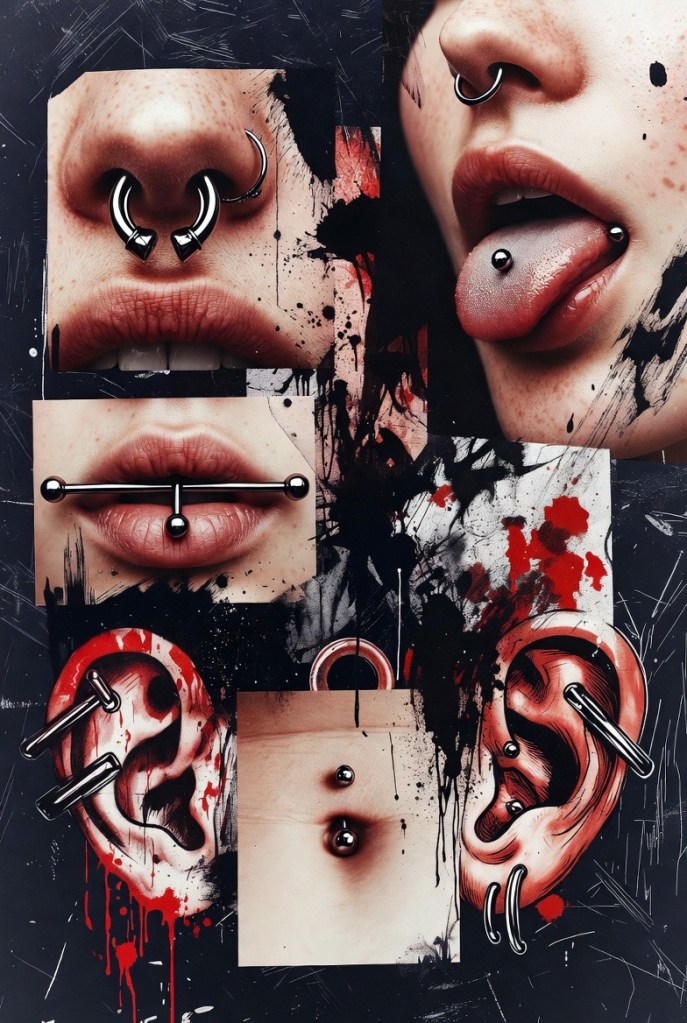
SEPTUM: A septum piercing is placed through the center of the nose between the nostrils. Easy heal and easy to hide for work, family or school.
LIP: Any piercing on or around the lips. A lot of swelling is to be expected with any lip piercing.
PHILTRUM: Also known as a Medusa piercing, is centered above the upper lip, in the groove just below the septum of the nose.
MONROE: Think of Marilyn Monroe’s beauty mark.
ASHLEY: The Ashley piercing consists in one end of the jewelry exiting at the center of the lower lip and the other end inside the mouth.
VERTICAL LABRET: A vertical labret piercing goes through the lower lip vertically, with one end of the jewelry resting on the top of the lower lip and exiting below it.
Body piercings
NAVEL: Widely known as a belly button piercing, this piercing is placed through the skin above the navel.
NIPPLE: Nipple piercings involve piercing nipples at the base of the nipple without going through the areola.
SURFACE: Surface piercings are placed on flat areas of the body, rather than through a traditional fold or protrusion of skin. Surface piercings can be prone to rejection and other issues even under the best circumstances. Especially single-point/microdermal/dermal piercings, which all have a single entry point in the body, have a particularly high rate of rejection.
You may be thinking of getting one yourself, but does it hurt getting a piercing?
There’s no easy answer to this question. Everyone feels a bit of pain when they get a piercing. However, everyone’s pain tolerance is different. Even your perception of pain can affect how much it hurts. If you’re excited about getting a piercing your experience may be totally different from someone who’s anxious. It’s certain that some piercings hurt much more than others and some have longer healing times, some can be uncomfortable for months. Here’s a general rule of thumb: The fewer nerves in the area, the less pain you’ll feel. A genital piercing would probably be the most painful, while a earlobe piercing one of the less painful.
Is piercing safe?
When done in a clean and professional environment, piercing is usually safe. But if piercing equipment is unclean, there is a risk of getting blood-transmitted diseases. These include: Hepatitis B, C and Tetanus. Although piercings are generally safe a risk of infection still exists. Properly caring for your piercings drastically reduces the chances that they will become infected.
Neglecting to closely follow aftercare instructions may result in inflammation of the pierced area. It is also possible to develop more serious physical consequences, such as the accumulation of pus to the infected area, hardening around the piercing and excessive bleeding.
A well-trained and experienced professional is a key factor for getting piercings done safely in a sanitary environment that lowers piercing risks. The quality of the piercing expert, the cleanliness and method of the piercing process drastically reduce the chances of developing an infection as a result of a poorly placed piercing or the utilization of unclean piercing equipment.
No matter where you choose to get pierced, make sure that you find an experienced professional to do it, and don’t forget to take good care of your new piercing.
How do I clean my piercing?
First of all, other than to clean your piercing, avoid touching it as much as possible—do NOT rotate or twist.
Prior to cleaning your new piercing, thoroughly wash your hands.
Spray the front and back of your piercing with sterile saline solution, 2 to 3 times a day for the first 2 weeks.
Rinse the pierced area (front and back) and surrounding with water to remove cleaning solution residue.
Dry the area by gently patting with clean, disposable paper products.
During the first few weeks, some bleeding, localized swelling, tenderness, and/or bruising is expected. Throughout your healing process, you may also notice some discoloration, itching, and the secretion of fluids (not pus) that will form some crust on the jewelry—this is also normal!
 Chirinkito tattoo & piercing