11 September 2026 · Chirinkito
AI and Tattoos: Is Artificial Intelligence Changing Tattooing Forever?
Artificial intelligence has entered almost every creative industry, and tattooing is no exception.
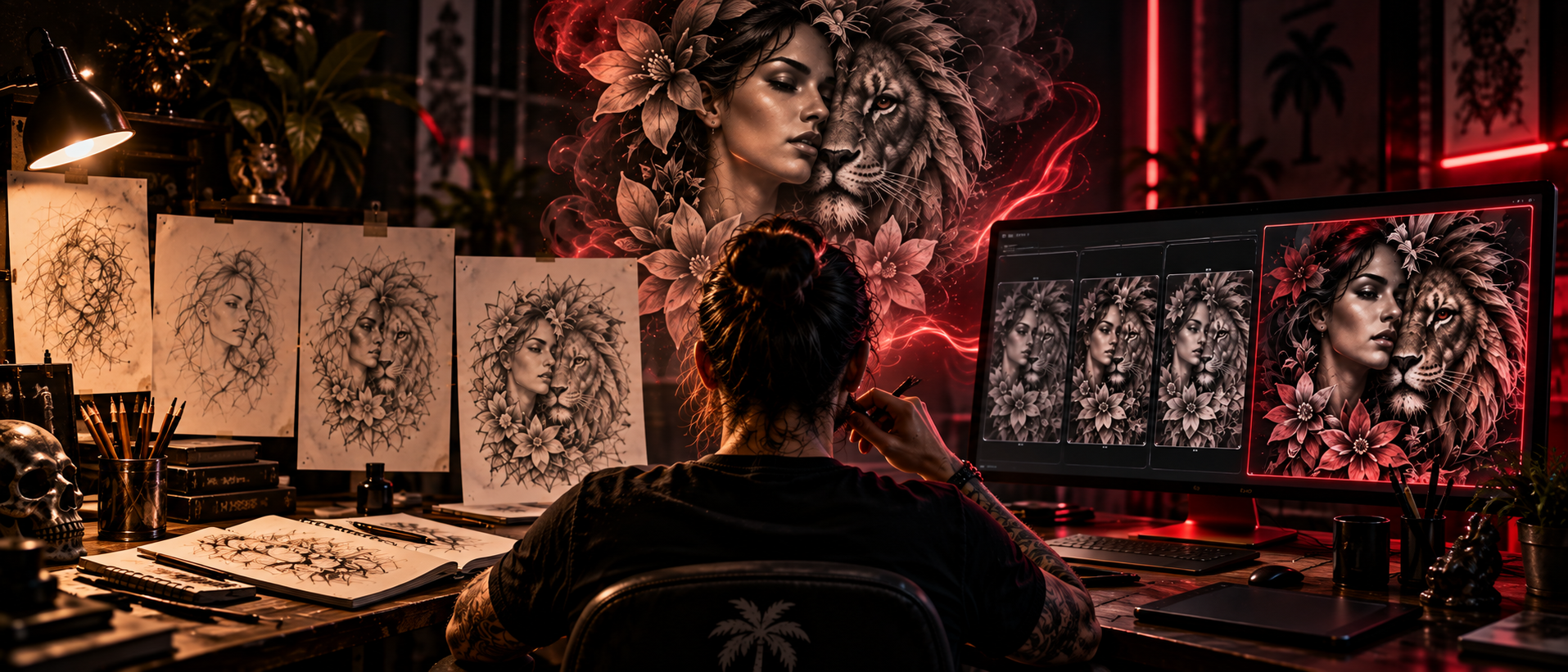
Today, a client can describe an idea to an AI system and, within seconds, receive an image that might previously have taken an artist hours to sketch. A tattoo artist can use AI to explore concepts, generate references, experiment with compositions or help a client turn a vague idea into something visual.
For some people, this is exciting.
For others, it is deeply uncomfortable.
There are questions about originality, artistic ownership and whether AI-generated tattoo designs devalue the work of professional tattoo artists. There are also practical questions. An image that looks spectacular on a screen might make a terrible tattoo once it has to work with the curves, movement and limitations of real human skin.
So, where does AI fit into tattooing?
Perhaps the more interesting question is not whether AI should enter the tattoo industry.
Perhaps it is:
How do tattoo artists choose to use it?
Tattooing has never been static
It is easy to look at AI and think that this is something completely unprecedented.
But tattooing has already experienced enormous technological changes.
Think about the evolution from traditional coil tattoo machines to rotary machines.
For generations, the coil machine was one of the defining tools of professional tattooing. When rotary machines developed and became increasingly sophisticated, they offered tattoo artists a very different way of working.
Not everyone immediately embraced them.
That is understandable. Artists become accustomed to the weight, vibration, sound and response of the equipment they use every day. A machine isn't simply a machine when it is an extension of your hand.
Tattoo artist Frank Rosenkilde documented this technological evolution in a 2015 historical review, describing the development from traditional coil machines through rotary and hybrid machines. He noted that increasingly refined rotary technology was becoming a trend because of its convenience and precision.
And yet, coils did not disappear.
Even today, artists have strong preferences about which machines they use.
That is perhaps the important lesson.
A new technology does not necessarily make the old technology worthless. It gives artists another option.
The same happened with stencils.
Tattoo artists traditionally prepared and transferred stencils using manual methods. Today, thermal stencil printers can produce a precise stencil in a fraction of the time.
Digital drawing created another major change.
Drawing tablets and software gave artists the ability to undo mistakes, duplicate elements, experiment with compositions and work digitally without putting pencil to paper.
Then came smartphones, social media and online portfolios.
A tattoo artist's work that might once have been seen only by people walking into a studio could suddenly be seen by thousands of people around the world.
None of these developments eliminated tattoo artists.
They changed what artists could do.
AI may simply be the next major step in that process.
A new tool doesn't automatically replace the artist
There is an important distinction here.
A wireless tattoo machine doesn't make someone a tattoo artist.
A stencil printer doesn't know where the stencil should be placed.
A drawing tablet doesn't understand how a design will age on skin.
And an AI image generator doesn't know how to tattoo the image it creates.
Technology can perform part of a process.
The artist is still responsible for deciding what happens next.
Colombian tattoo artist Sebastián González has described technology, including AI, as an interesting tool for tattoo art, particularly during the design and conceptualisation phase. Although he prefers to draw by hand, he says technological applications can help him visualise ideas and show clients how a tattoo might look on their skin.
That is perhaps one of the most reasonable ways to look at AI:
not as the artist, but as another tool available to the artist.
An impressive AI image isn't necessarily a good tattoo
This is where tattooing is different from simply creating an image.
AI can produce an impressive picture.
But a tattoo is not a picture on a screen.
It is an image translated onto a three-dimensional, living and changing surface.
Skin has texture. Bodies have curves. Arms bend. Hands move. Designs stretch and distort. Ink ages.
A successful tattoo therefore requires decisions that have little to do with whether an image looks impressive on a computer screen.
Where should the design sit? How should it follow the anatomy? How much detail can realistically be tattooed? What happens when fine details soften? What line weight will survive? What should be removed rather than added?
These are tattooing decisions.
And AI doesn't necessarily make them for you.
This is one of the issues raised by Hungarian tattoo artist Brigi Fuzes, who uses AI-generated images as references. In a September 2026 interview with Euronews, Fuzes explained that AI-generated images can contain extremely fine details that look convincing digitally but may not translate well into skin or remain clear as a tattoo ages.
Her approach is particularly interesting because she does not treat the AI image as the finished tattoo.
She described one of her works by saying:
"This is also edited with AI. But this is my tattoo."
The distinction is important.
The reference may have involved AI.
The tattoo is still the artist's interpretation and adaptation.
Fuzes also told Euronews that around 70% of her customers now arrive with AI-generated images.
Whether that number will remain the same in the future is impossible to know, but it illustrates how quickly AI-generated tattoo references are becoming part of the consultation process.
And there is a strange irony here.
The better AI becomes at producing visually perfect images, the more important it may become for a tattoo artist to know what to remove.
A good tattoo isn't necessarily the image with the most detail.
Sometimes the artist's most important decision is knowing which details don't belong in the tattoo.
But here is the uncomfortable question
There is a question that could make some tattoo artists uncomfortable:
If a realism artist tattoos from a photograph, how different is that from tattooing an AI-generated image?
Think about a realism tattoo.
A client brings a photograph of a person, an animal, a landscape or another subject.
The tattoo artist uses that photograph as the foundation for the tattoo.
The photograph was not created by the tattoo artist.
Yet using photographic references is completely normal in tattooing.
So why should an AI-generated image automatically be considered fundamentally different?
There are certainly differences.
A photograph has a photographer. There may be a person whose likeness appears in the photograph. There can be questions about copyright, permission and ownership.
AI-generated images raise a different set of questions about how they were produced, what material influenced the system and who should be considered the creator of the final image.
But there is another distinction that may be even more important:
Reference is not necessarily reproduction.
A tattoo artist can look at a photograph and create something substantially different from it.
They can change the composition, adapt it to the body, combine several references, redraw elements and make hundreds of artistic decisions.
The same can happen with an AI-generated image.
A client might show an AI image and say:
"I like the atmosphere, the composition and the way these elements work together."
That image can become a starting point for an original tattoo.
But what if the client says:
"I want this exact AI image. Don't change anything."
Now the conversation becomes much more complicated.
And interestingly, that problem isn't exclusive to AI.
The same question exists when someone brings another tattoo artist's work into a studio and asks for an exact copy.
The technology may be different.
The ethical question is surprisingly similar.
Where does inspiration end and copying begin?
This may actually be the oldest question in this entire discussion.
Tattooing has always involved references.
Artists study other artists. Clients bring photographs. Artists look at paintings, sculptures, nature, books, films, architecture and other tattoos. Tattoo artists combine influences and develop their own visual language.
So the existence of references isn't new.
What AI changes is the speed and scale at which new references can be produced.
A client who previously needed to search hundreds of images online can now generate dozens of completely different concepts in minutes.
That can be incredibly useful.
It can also create problems.
What happens if the generated image closely resembles the work of a particular artist? What happens if a client wants that exact style? What happens if an artist uses AI to imitate another artist's work? And who should receive credit?
There are no universally simple answers.
AI as another design tool
Edinburgh-based tattoo artist David Corden sees AI as the latest addition to tools artists were already using.
Before AI, artists could use software such as Photoshop to construct and manipulate detailed reference images.
Corden now also uses AI to help improve old or blurry photographs, including photographs of deceased relatives that clients want turned into tattoos.
This is an important example because AI doesn't have to generate the tattoo design from scratch.
It can solve a much smaller problem. It can improve a reference. It can help visualise an idea. It can help combine elements. It can help a client communicate. It can help an artist explore possibilities.
In other words:
AI doesn't have to be the creative process. It can simply be part of the creative process.
What if the client brings an AI tattoo to the studio?
This is probably going to become increasingly common.
A client walks into a studio with an AI-generated image and says:
"I want this."
An artist could simply reproduce it.
But perhaps there is a better question:
"What do you actually like about this image?"
Maybe the client likes the expression. Maybe they like the composition. Maybe they like the combination of a particular animal and a particular flower. Maybe they like the mood but don't actually care about the exact image.
Suddenly, the AI image becomes something useful.
It becomes a communication tool.
This isn't entirely different from a client bringing ten photographs to a consultation and saying:
"I like this part of this one, this style from this one and the composition of this one."
The artist's job is then to understand the client's intention and translate it into something that works as a tattoo.
Interestingly, tattoo artist Ellie Diamond told Euronews that when clients bring AI-generated mock-ups, she is willing to use the idea as a starting point, but believes the artist can develop something better suited to the client and the tattoo. She also argued that some of the strongest tattoos come from clients explaining their idea and then allowing the artist to interpret it.
That is another possible future for AI:
Not replacing the consultation.
Improving it.
The coil machine lesson
There is an interesting parallel here.
When rotary machines became increasingly popular, there were artists who preferred their traditional coil machines.
Some questioned whether rotary machines could provide the same power or "hit" they were accustomed to. Others simply didn't like the feel.
And even today, you can find tattooers who passionately prefer coils.
But rotary machines eventually became an established part of professional tattooing.
That doesn't mean coils became obsolete.
It means artists gained another option.
The history of tattoo equipment is full of this kind of evolution. Rosenkilde's historical review describes the progression from traditional coil machines through rotary and hybrid systems, as well as developments in needles, disposable equipment and hygiene practices.
Perhaps AI will follow a similar path.
Or perhaps it won't.
That is one of the interesting things about technological change:
We usually don't know which developments will become essential and which will disappear.
The Chirinkito perspective: use the tool, don't become the tool
At Chirinkito, we don't see AI as a replacement for artistic thinking.
We use AI as a tool.
We can use it to push the boundaries of imagination, explore ideas that might otherwise be difficult to visualise, experiment with combinations of concepts and help our artists see possibilities from different perspectives.
It can also make many everyday tasks easier.
That doesn't mean we want AI deciding what a tattoo should be.
It means we can use technology to spend more time on the things that actually require an artist.
The interesting part isn't simply asking AI:
"Make me a tattoo."
The interesting part is asking:
"What if?"
What if these two ideas were combined? What if the composition worked differently? What would this concept look like from another perspective? What happens if we push this idea further?
AI can be very good at opening doors.
The artist still decides which door is worth walking through.
And once the idea reaches the skin, the technology becomes only one part of a much bigger process.
The artists who don't want AI
A neutral discussion also has to acknowledge the opposite position.
Not every artist believes AI is simply another harmless tool.
Some artists see generative AI as fundamentally different from previous technologies because of the way it can reproduce or imitate existing creative styles.
Others believe that part of the value of art lies precisely in the human process of creating it.
Some artists simply don't want AI involved in their work.
Those positions are legitimate.
There is no requirement for every tattoo artist to adopt every new technology.
In fact, the current tattoo industry already demonstrates very different attitudes toward technology.
Euronews recently spoke with tattoo artist Tiago Miranda, who creates his dark designs primarily from his own imagination and hundreds of pencil sketches rather than relying on reference photographs. Tattoo artist Ellie Diamond is also cautious about AI, although she increasingly encounters AI-generated images brought in by clients.
There is room for both approaches.
AI as a creative instrument
There are also artists working outside tattooing who see AI very differently.
Media artist Refik Anadol has described AI as a "thinking brush," arguing that machine intelligence can expand the possibilities available to artists.
His work raises a useful question for tattooing.
A brush doesn't decide what a painter wants to say.
A camera doesn't decide what a photographer wants to photograph.
A tattoo machine doesn't decide what should be tattooed.
Perhaps AI belongs in the same category.
Perhaps the important question isn't whether the tool is intelligent.
Perhaps it is:
Who is holding the creative responsibility?
Could AI replace tattoo artists?
This is where predictions become difficult.
AI is improving rapidly, and it is reasonable to assume that its capabilities will continue to expand.
But designing a tattoo and tattooing a person are two very different things.
Even if AI eventually becomes extraordinarily good at generating tattoo designs, someone still has to make the physical mark on the skin.
There are also human aspects of tattooing that are difficult to reduce to image generation.
A tattoo appointment involves communication, trust, judgement and personal interaction.
The artist needs to understand the client, assess the placement, consider the anatomy, make adjustments and physically execute the work.
And perhaps most importantly:
The client isn't buying a JPEG.
They are permanently placing something on their body.
That human relationship remains an important part of tattooing.
Veteran tattoo artist Dan Gold recently told Euronews that he does not expect AI to take over his job. His bigger concern is how generative AI systems obtain the creative material used to train them.
That is another important part of the debate.
AI may not replace the tattoo artist.
But it can still raise serious questions about how creative work is collected, used and valued.
But tattoo artists should also be allowed to say no
Being open to technology doesn't mean every artist has to use it.
Some artists may believe that designing everything themselves is an essential part of their creative identity.
Others may have concerns about how AI systems are trained.
Some may simply enjoy the traditional process of drawing.
Those positions are legitimate.
There is no requirement for every artist to adopt every new technology.
Tattooing has always contained different approaches. Some artists prefer coils. Some prefer rotary machines. Some draw everything by hand. Others work digitally. Some use stencil printers. Others prefer traditional methods.
Technology gives artists options.
It doesn't necessarily dictate which options they have to choose.
So, should tattoo artists use AI?
There probably isn't one correct answer.
One artist may decide never to use it. Another may use it only for brainstorming. Another may use it extensively as part of their creative workflow. Another may use it mainly to help clients communicate their ideas.
The important thing is not necessarily whether AI is being used.
It is how it is being used.
There is a significant difference between:
"AI made this tattoo design for me."
and:
"AI helped me explore an idea, and I used that exploration as part of my design process."
The artist's role hasn't necessarily disappeared in the second example.
It may actually become more important.
The artist still has to decide what is useful, what is wrong, what needs to be changed and what will work permanently on someone's skin.
The next technological change
It is impossible to know exactly where AI will take tattooing.
Maybe AI will eventually become an everyday part of tattoo design. Maybe artists will mainly use it for brainstorming. Maybe clients will eventually stop bringing photographs and start bringing AI-generated concepts. Maybe completely new tattoo styles will develop because artists have access to visual possibilities that were previously difficult or impossible to explore.
There will almost certainly be problems we haven't considered yet.
But that has happened with every major technological change.
The transition from coil machines to rotary machines didn't end tattooing. Wireless machines didn't end tattooing. Digital drawing didn't end tattooing. Stencil printers didn't end tattooing. Social media didn't end tattooing.
They changed it.
AI will probably change it too.
The tool changes. The responsibility remains.
Perhaps this is where the discussion ultimately comes down to.
Technology can generate an image. It can modify a photograph. It can create a reference. It can print a stencil. It can help visualise a tattoo on a body. It can make some parts of the creative process faster.
But none of those things automatically answer the most important question:
What should permanently go onto this person's skin?
That decision still requires judgement.
So perhaps the real debate isn't:
"Should AI be allowed in tattooing?"
Perhaps it is:
"How should tattoo artists choose to use AI?"
One artist may decide never to touch it. Another may use it for brainstorming. Another may use it extensively. Another may use it simply as a way of helping clients explain what they want.
There may not be one correct answer.
And perhaps that is exactly what makes the discussion interesting.
The history of tattooing is full of technological changes. The tools have evolved dramatically, but the fundamental relationship remains remarkably simple:
A person wants something permanently placed on their body.
Another person has the skill and responsibility to make that happen.
The technology between those two people may continue to change.
The responsibility doesn't.
The question isn't whether AI will enter tattooing. It already has.
The question is what tattoo artists — and the industry as a whole — choose to do with it.
Sources & Further Reading
Euronews — "Would you let AI design your next tattoo? Tattoo artists say AI is changing the way they work." A current 2026 report featuring tattoo artists including Brigi Fuzes, David Corden, Tiago Miranda, Ellie Diamond and Dan Gold, discussing AI-generated references, design, originality and the future of tattooing.
Frank Rosenkilde — "Tattoo machines, needles and utilities," Current Problems in Dermatology, 2015. A historical overview written by a professional tattoo artist who began tattooing in 1977 and documented the development of coil, rotary and hybrid machines and other tattoo equipment.
iNKPPL — "A Master of Many Styles: Sebastián González on Creative Freedom and Artistic Diversity." An interview with Colombian tattoo artist Sebastián González discussing technology, AI, drawing and visualising tattoo concepts.
Google — Refik Anadol on AI and creativity. A discussion with the internationally recognised media artist about artificial intelligence as a creative tool and his description of AI as a "thinking brush."
A final thought from Chirinkito
Technology has always been part of the evolution of tattooing.
The machines changed. The needles changed. The way we draw changed. The way we transfer designs changed. The way clients find artists changed.
Now the way we imagine and develop ideas is changing too.
We don't know exactly where AI will take tattooing.
But perhaps we don't need to.
The future of tattooing won't be decided by AI alone. It will be decided by the artists who choose how to use it.